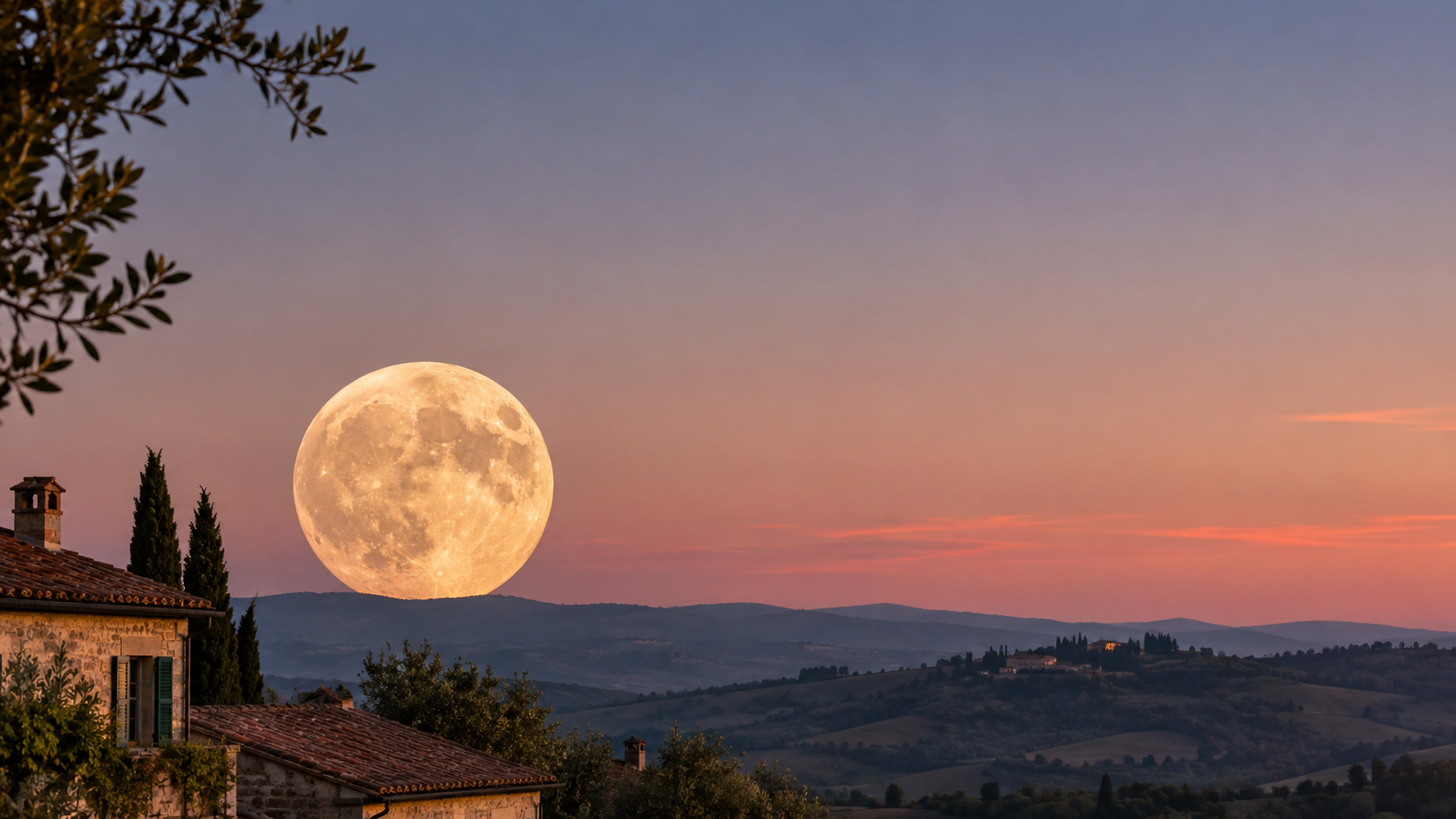
A full Moon hanging above a row of houses can look large enough to touch the rooftops. A few hours later, when the same Moon is high overhead, it seems to have shrunk. Astronomers call this the Moon illusion, and you can test it without a telescope.
Measure the Moon instead of judging it
Hold a small object at arm’s length and compare its width with the Moon when the Moon is low. Repeat the comparison later, keeping your arm and the object in the same position. Alternatively, photograph it twice with the same camera and zoom setting. The Moon’s width in the two images will be much more similar than your impression of its size would suggest.
The Moon’s orbit does make its apparent diameter vary over the course of a month. A full Moon near the closest part of its orbit can look somewhat larger than one near the farthest part. That real difference, however, is distinct from the dramatic impression of size that can occur during a single evening.
Your brain is part of the view
One proposed explanation concerns perceived distance. Buildings, trees and other features near the horizon give the visual system depth cues that are largely absent from an open sky overhead. How the brain combines perceived distance and angular size may change the impression of the Moon. Yet NASA notes that no single explanation has fully settled the question.
The atmosphere does affect the Moon’s appearance. Low in the sky, moonlight travels through more air. Shorter wavelengths scatter more readily, often giving the Moon a warmer color. Atmospheric refraction can also flatten its vertical shape slightly. Neither effect accounts for the apparent enlargement.
Why photographs can be misleading
A photographer using a long lens can frame the distant Moon beside a distant building and produce a dramatic image. Such a photograph is not evidence that the atmosphere magnified the Moon. It is a consequence of framing and perspective. The unassisted Moon illusion remains an intriguing example of the difference between measuring an object and experiencing its size.
Source: NASA Science, The Moon Illusion.
AI generated editorial illustration. The apparent size of the Moon is intentionally exaggerated; this is not a photograph.